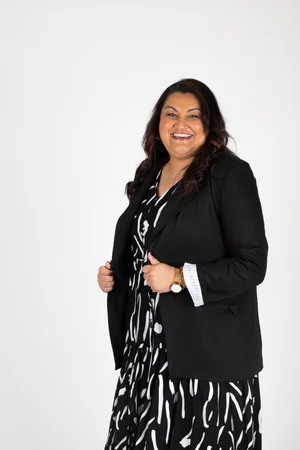
Say Yes. Confidence will catchup.
Others see what you’re capable of before you do.
Two months into a new role, I was due to attend my own staff orientation.
Then I was asked a question I wasn’t expecting.
Would I like to emcee it?
I realised, I wasn’t just going to experience orientation as a relatively new employee. I was going to help lead around 30 people through theirs. Responsible for holding the room, connecting the dots and helping create an experience that made people feel welcomed, informed and connected to their new organisation.
A total of four hours with the help of colleagues, who are the real MVPs!
My answer was yes. However, my internal dialogue took slightly longer to catch up.
A fleeting moment of: Who am I to do this? I’ve only been here two months.
Followed by…
Hang on. I know how to do this.
I’m trained in public speaking and facilitation and connect people all the time. I’ve stood in rooms before and taken people on a journey. This wasn't about developing a new capability. It was about trusting one I already had and this time in a new environment.
And perhaps that’s one of the interesting things about opportunity.
Sometimes other people recognise that you're ready before you feel ready yourself.
They asked you for a reason
We often hear the phrase, do it scared. Which has a lot of truth in it, but I think there’s another layer.
When someone asks you to step up, lead something, speak, facilitate or take on more responsibility, they’ve already assessed you can complete the task.
They see something – your skills, experience, capability and trust you can do it.
Meanwhile, we're standing there wondering whether we belong in the room.
The question goes from Am I ready? To What are they seeing in me that I need to remember about myself?
Being nervous doesn't mean you're incapable, it means you're human and apparently nerves and excitement evokes those same feelings.
So, with this very important role to deliver my preparation kicked in with practice, supported by prior experience, I was ready to roll.
Nobody is thinking about you as much as you are
As I opened the session, there were nerves as I looked across the room to my new colleagues. In a new organisation, a whole new country and audience to test some of my emcee jokes, some landed, some didn’t!
Even my opening was different.
In Aotearoa New Zealand, accustomed to introducing ourselves with a mihi (a greeting, acknowledgment, or speech of thanks in Māori culture) and pepeha (a traditional Māori way of introducing yourself by sharing your genealogical and ancestral connections to the natural land). Here in Australia, I am learning the significance and responsibility of giving an Acknowledgement of Country.
This was only my second time doing one and I wanted to do it justice.
Coming from a multicultural heritage myself (Chinese, Fijian, Indian) and having previously worked in a Pacific workforce development role, I understand that culture carries nuance. We move between different communities, environments and ways of acknowledging people. We never know everything but continue the willingness to learn and embrace.
So yes, I felt nervous, but nerves have a wonderful way of making us believe everybody is examining us as closely as we're examining ourselves.
They're usually not. Your audience is thinking about their own experience.
What am I going to learn?
Do I feel comfortable here?
Was giving my time to this worthwhile?
My job wasn't to wonder what 30 people thought of me. It was to honour the time they’d given me.
Your experience travels with you
There was another reminder in that room too. Which is nothing we have done before is ever completely wasted.
From different jobs held, various communities we belong, countries we’ve lived in. They all post both challenges and opportunities.
They create threads. My previous work, my cultural experiences, public speaking, facilitation, and communication all walked into that room with me.
Sometimes we become so focused on being new that we forget we're not starting from zero. You're simply bringing everything you've learned into a new context.
That's adaptability.
Not having every answer before you begin but being able to draw on what you already know, read the room you're in and adjust accordingly.
The more you practise this mindset, the unfamiliar becomes familiar.
One day, I hope my Acknowledgement of Country will flow without needing to read from the page. Because then I’ll know my understanding and confidence in delivering them will have grown.
That's what stepping up gives us and we sharpen our skills by saying yes.
Three observations from my week
Someone else's belief in you can be useful evidence. If you've been invited to step up, don't discount what that person recognises in you. Put yourselves in their shoes.
Nerves don't cancel capability. Preparation, practice and experience sit alongside nervousness. You don't need to eliminate one before using the other.
Your audience isn't there to judge your internal dialogue. Whether you're presenting, leading or facilitating, move your attention away from yourself and towards the experience you're creating for them.
So, what opportunity are you hesitating over because you're waiting to feel ready?
Confidence doesn't always come before the yes. The yes is how it’s built.
The sweetest way to finish my week was receiving this gift, a piece of home from a fellow kiwi workmate. When I saw this coming toward me, you bet, I said YES!

Piece of home!
Adaptability isn't having everything figured out. It's trusting what you already have, stepping into what comes next, allowing yourself to grow into the opportunity.
Until next week,
Zee
Power in Change reflects on adaptability, leadership and the small shifts that help us move with change.
Move with Confidence | Adaptability Advantage Podcast Host